



The Question Everyone Asks
“How long until I feel better?”
It’s the first question I asked after “Am I burned out?” I was exhausted, depleted, barely functioning. I wanted to know when this ends.
The answer I (probably you too) don’t want to hear: Burnout recovery takes Months, not weeks.
Maybe you’ve already been “working on it” for a few weeks. You’ve tried meditation apps, taken a long weekend, promised yourself you’ll set boundaries. But you still wake up exhausted. Your brain still feels foggy. Work still feels impossible.
And you’re wondering: “What am I doing wrong? Why isn’t this working faster?”
You’re not doing anything wrong. Recovery just takes longer than anyone tells you.
What You’ll Learn:
- Why everyone expects burnout recovery to be fast (and why those expectations are wrong)
- What’s actually happening in your body during recovery (the biology, not just the psychology)
- Realistic timelines based on burnout severity
- The three factors that affect YOUR specific timeline
- My own recovery timeline (from near-stroke to sustainable living)
- What speeds recovery vs. what delays it
- The permission you need to take the time this actually requires
This isn’t another “be patient with yourself” platitude. This is the scientific and practical truth about why recovery takes as long as it does – and how to not waste time during it.
Table of Contents:
- Why People Expect Fast Recovery
- What’s Actually Happening in Your Body
- The Timeline Reality
- My Own Recovery Journey
- Three Factors That Affect Your Timeline
- What Speeds Recovery (And What Delays It)
- The Permission You Need
Why People Expect Fast Recovery
Let’s be honest about where the “quick fix” expectation comes from.
1. The Self-Help Industrial Complex
What they promise:
- “7 Days to Beat Burnout!”
- “Weekend Reset for Total Recovery”
- “30-Day Burnout Cure”
Why it’s wrong:
These programs confuse acute stress relief with burnout recovery.
Taking a weekend off might help you recover from a stressful week. It won’t help you recover from months or years of chronic depletion.
It’s like trying to treat chronic malnutrition with a single big meal. One meal helps, but it doesn’t undo months of inadequate nutrition.
2. The Acute Illness Model
How we think about recovery:
Most illnesses we experience are acute:
- Get flu → Rest a week → Feel better
- Sprain ankle → Ice and elevate → Heals in weeks
- Get food poisoning → Awful for 24 hours → Back to normal
We apply this model to burnout:
“I’m sick” → “I’ll rest” → “I’ll be better soon”
Why it doesn’t work:
Burnout isn’t an acute illness. It’s chronic damage accumulated over months or, in my case, years.
The right model: Recovering from a broken bone, not recovering from a cold.
You don’t just rest a broken leg for a weekend and expect to run marathons. You need:
- Immediate stabilization (cast, immobilization)
- Weeks of healing (bone knitting back together)
- Months of physical therapy (rebuilding strength)
- Careful return to activity (gradual load increase)
Burnout recovery follows the same pattern.
3. Underestimating the Depth of Depletion
Most people don’t realize how burned out they actually are until they try to recover.
You’ve been operating on empty for so long that empty feels normal. You’ve forgotten what “not exhausted” feels like.
The iceberg effect:
What you see: Exhaustion, irritability, trouble focusing.
What’s actually damaged: Nervous system, stress response, cognitive function, emotional regulation, sleep architecture, immune function ( more about this further in the article)
You’re not just tired. You’re physiologically depleted at multiple system levels.
4. Confusion Between Rest and Recovery
Rest = Stopping the drain
Taking time off, sleeping more, not working evenings.
Recovery = Actively rebuilding
Nervous system recalibration, establishing new patterns, healing damaged systems.
Rest is necessary but not sufficient.
The analogy:
Rest stops the bleeding. Recovery heals the wound.
You need both. And healing takes time after you stop the bleeding.
What’s Actually Happening in Your Body
This isn’t just “you need time to feel better.” This is biological repair happening on multiple levels.
1. Nervous System Recalibration
What burnout did:
Your nervous system has been stuck in sympathetic activation (fight-or-flight mode) for months or years. It forgot how to fully activate the parasympathetic system (rest-and-digest mode).
What recovery requires:
Your nervous system needs consistent, repeated signals over weeks and months that it’s safe to relax.
The timeline:
Research on stress recovery shows that it takes 8-12 weeks of consistent lower-stress signals for the nervous system to start recalibrating its baseline.
Think of it like recalibrating a thermostat. One cool day doesn’t reset it. You need weeks of consistent temperature before the system adjusts.
What this feels like:
Weeks 1-5: Still anxious, still wired, sleep still disrupted Weeks
6-9: Starting to notice moments of calm Weeks
9-12+: Nervous system beginning to trust safety
This is why you can do “all the right things” for 2-3 weeks and still feel terrible. Your nervous system is just starting to believe the emergency is over.
2. Cortisol Regulation Restoration
What burnout did:
Your stress hormone (cortisol) has been elevated chronically. This affects:
- Sleep-wake cycles
- Immune function
- Metabolism
- Emotional regulation
- Cognitive function
What recovery requires:
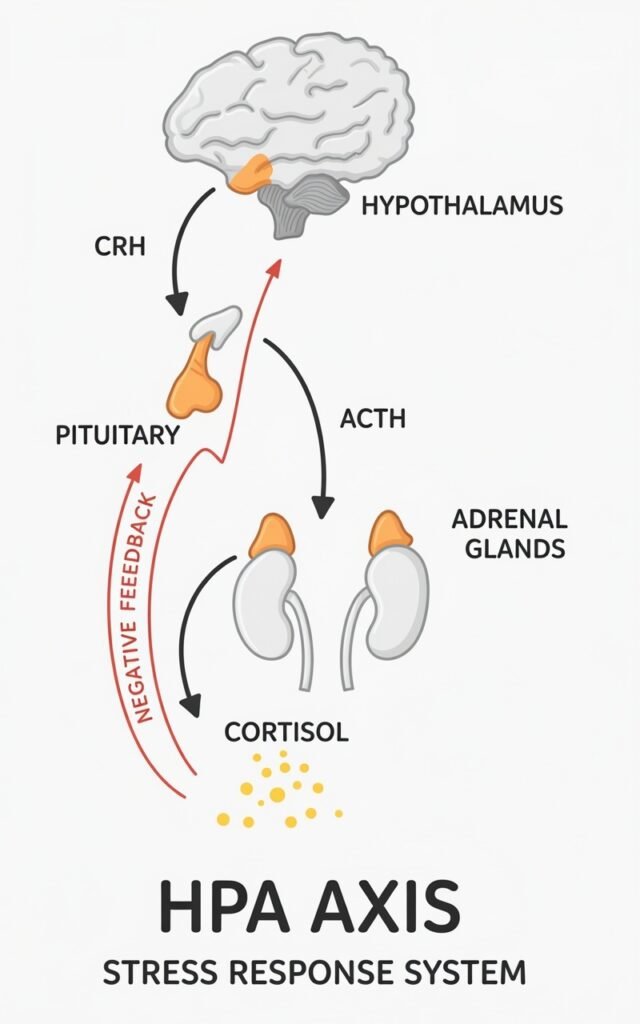
Your HPA axis (hypothalamic-pituitary-adrenal axis) needs to relearn normal cortisol rhythms.
Months or years of stress change baseline stress‑system set‑points and make down‑regulation harder, which is why you have forgotten how to fully activate parasympathetic mode.
Normal: Cortisol high in morning, low at night ]
Burnout: Cortisol dysregulated – high at night, low in the morning, or flatlined entirely
The timeline:
Studies on HPA axis recovery show 3-6 months minimum for regulation to normalize after chronic stress, and over a year for a severe burnout.
What this feels like:
Month 1: Still waking at 3 AM, still wired at night
Month 2: Sleep starting to consolidate slightly
Month 3: Beginning to feel tired at appropriate times
Months 4-6+: Sleep architecture approaching normal
This is biological. You can’t willpower your way to faster cortisol regulation.
3. Sleep Architecture Repair
What burnout did:
Chronic stress disrupts sleep stages. You might be getting hours in bed, but not getting restorative sleep.
Deep sleep (when physical repair happens) gets suppressed. REM sleep (when emotional processing happens) gets fragmented.
What recovery requires:
Your brain needs weeks of consistent sleep opportunity to rebuild proper sleep architecture.
The timeline:
Sleep research shows 6-12 weeks of sleep opportunity before architecture normalizes after chronic disruption.
What this feels like:
Weeks 1-3: More hours but still not restorative Weeks
4-6: Starting to wake feeling slightly less terrible Weeks
7-12: Occasional mornings feeling actually rested
You can’t “catch up” on months of poor sleep in one good weekend.
4. Cognitive Function Recovery
What burnout did:
Chronic stress actually changes brain structure:
- Hippocampus (memory) shrinks
- Prefrontal cortex (decision-making) shows reduced activity
- Amygdala (fear/stress response) becomes hyperactive
What recovery requires:
These changes are reversible, but it takes time. Neuroplasticity (brain’s ability to change) works, but slowly.
The timeline:
Studies on stress-induced brain changes show 6 months to Years of reduced stress before structural changes begin reversing.
What this feels like:
Month 1: Still foggy, decisions still hard
Month 2: Occasional moments of clarity
Month 3: Brain fog lifting more consistently
Months 6 and beyond: Thinking feels closer to normal
Decision paralysis, brain fog, memory issues – these aren’t permanent, but they don’t resolve quickly.
5. Emotional Regulation Restoration
What burnout did:
Your emotional regulation system is exhausted. You’re either numb or overwhelmed, with no middle ground.
What recovery requires:
Your nervous system needs to feel safe enough to re-engage emotional processing.
The timeline:
Emotional numbness typically starts lifting 12 weeks to 12 Months into consistent recovery practices.
What this feels like:
Weeks 1-8: Still flat or still overwhelmed
Weeks 9-12: First glimmers of appropriate emotion
Months 4-6: Emotional range returning
Months 6-12: Emotions feel proportionate again
Feeling things again is a sign of healing, not a setback.
The Timeline Reality: How Long Based on Severity
Let me be specific about what “months” actually means for different severity levels.
Early Stage Burnout (3-5 Warning Signs)
Characteristics:
- Exhausted but still functioning
- Some physical symptoms
- Can still make decisions (though it’s harder)
- Haven’t had health crisis
- Caught it relatively early
Realistic Timeline: 3 to 6 Months
Week-by-week:
- Weeks 1-4: Stabilization (stopping the bleeding)
- Weeks 5-8: Foundation building (consistent routines)
- Weeks 9-12+: Rebuilding (feeling like yourself again)
What “recovered” looks like:
- Can get through days without feeling depleted
- Sleep is regular and restorative
- Brain fog mostly cleared
- Emotional regulation back
- Can handle normal stress
Key factor: If you consistently maintain boundaries and protect recovery time, 3 to 6 months is realistic.
Moderate Burnout (6-9 Warning Signs)
Characteristics:
- Functioning but barely
- Significant physical and emotional symptoms
- Brain fog, decision paralysis
- Quality of life seriously impacted
- Multiple system involvement
Realistic Timeline: 6 to 12 months
Month-by-month:
- Months 1-2: Crisis management and stabilization
- Months 3-4: Foundation building and early improvements
- Months 5-6+: Rebuilding identity and sustainable patterns
What “recovered” looks like:
- Consistent energy through most days
- Work doesn’t feel like constant battle
- Can think clearly most of the time
- Starting to feel like yourself again
- Building sustainable life, not just surviving
Key factor: If you stay in toxic environment or don’t make significant changes, this extends to 12 to 18+ months.
Severe Burnout (10+ Warning Signs or Health Crisis)
Characteristics:
- Barely functioning or not functioning
- Health crisis (ER visit, breakdown, panic attacks)
- Can’t think clearly or make decisions
- Complete depletion across all domains
- Multiple serious symptoms
Realistic Timeline: 12 to 24+ months
Quarter-by-quarter:
- Q1 (Months 1-3): Crisis stabilization, stopping work if possible
- Q2 (Months 4-6): Slow rebuilding, establishing minimum routines
- Q3 (Months 7-9): Identity reconstruction, sustainable patterns emerging
- Q4 (Months 10-12+): Integration, living sustainably
What “recovered” looks like:
- Can work sustainably (not just survive it)
- Energy for life outside work
- Emotional range returned
- Cognitive function mostly normal
- Feel like a new version of yourself (not the old one)
Key factor: At this severity, your burnout recovery takes months or even years. Trying to work full-time while recovering significantly extends the timeline. An extended leave or exit is often necessary.
My Own Recovery Timeline
Let me share my specific journey – not because yours will be identical, but so you see what real recovery actually looks like.
My Starting Point: Severe
The crisis:
- Near-stroke (medical emergency)
- 10+ warning signs present
- Cognitive function severely impaired
- Complete emotional numbness
- Physical symptoms multiple and severe
Burnout severity: Severe (probably 12-13 out of 13 signs)
Workplace toxicity: High (covert becoming overt, systemic dysfunction)
Control: Moderate (could negotiate some changes, but limited)
Months 1-3: Crisis Stabilization
What I did:
- Negotiated few days off to rest
- Started morning routine (meditation, journaling, exercise)
- Negotiated late start to protect morning time
- Set boundary: No work evenings or weekends
- Lowered all standards to “barely good enough”
What I felt:
- Still exhausted constantly
- Brain fog thick
- Decisions still nearly impossible
- Sleep slightly better but not restorative
- No joy, no interest, just surviving
The temptation: “This isn’t working, why am I still so tired?”
The reality: I was stabilizing, not recovering yet. The bleeding was slowing, but the wound wasn’t healing yet.
Months 4-7: First Glimmers
What I did:
- Maintained morning routine religiously
- Work-from-home 1-2 days per week
- Continued boundaries despite pressure
- Started journaling about values and identity
- Focused on what I could learn vs. what I couldn’t control
What I felt:
- Occasional moments of clarity (like clouds parting)
- Sleep consolidating – some mornings felt okay
- Brain fog lifting slightly
- First hints of actual emotion (not just numbness)
- Could make simple decisions more easily
The temptation: “I feel better! Maybe I can add more back in.”
The reality: I was stabilizing MORE, starting earliest stages of actual recovery. Still fragile. One stressful week could undo weeks of progress.
Months 5-9: Rebuilding
What I did:
- Maintained all boundaries (no backsliding)
- Expanded recovery activities (reading, learning)
- Realized system was beyond my ability to fix
- Shifted to “what can I learn while I’m here?”
- Prepared mentally and financially for eventual exit
What I felt:
- Consistent energy through most days
- Could think creatively again
- Emotional range returning (joy, sadness, interest)
- Started feeling like myself again (different self, but myself)
- Work still draining but not destroying
The shift: From “trying to survive” to “building something sustainable.”
Months 8+ and Beyond : Integration and Reinvention
What I did:
- Took time for deep rest and reflection
- Used it for deeper recovery, not rushing into next thing
- Built clearer criteria for the ideal role
- Focused on writing and creating
- Solidified sustainable practices
What I felt:
- Actually good (not just “not terrible”)
- Creative energy returning
- Clear about what matters
- Confident in boundaries
- Different person than who started
Now:
Where I am:
- Sustainable work that aligns with values
- Morning routine non-negotiable and automatic
- Boundaries feel natural, not effortful
- Warning signs? I catch them at sign 1-2, not 10+
- Living life I don’t need to constantly recover from
Was it worth taking the time? Absolutely. Rushing would have meant crashing again within months.
The Three Factors That Affect YOUR Timeline
Why do some people recover in 3 months while others need 2 years? Three factors:
Factor #1: Burnout Severity (The Starting Point)
Simple rule: The more damage, the longer repair takes.
- 3-5 warning signs = 3-6 months
- 6-9 warning signs = 6-12 months
- 10+ warning signs = 12-24+ months
You can’t rush biological healing. A broken finger heals faster than a shattered pelvis. Same principle.
Factor #2: Consistency of Recovery Practices
The principle: Consistent moderate effort beats sporadic intense effort.
Fast recovery (within timeline range):
- Boundaries held daily
- Recovery practices maintained consistently
- Standards stayed lowered
- No backsliding when you feel better
Slow recovery (extended timeline):
- Boundaries set then abandoned
- Recovery practices sporadic
- Standards raised too soon when you feel slightly better
- “I don’t need this anymore” → crash → restart cycle
My example:
I held boundaries even when:
- Projects were “urgent”
- People pushed back
- I felt guilty
- I felt better and was tempted to add more
That consistency = within expected timeline.
If I’d caved on boundaries every few weeks? Add 6+ months to timeline.
Factor #3: Environment (Toxic vs. Salvageable)
The principle: You can’t heal in the environment that made you sick (or it takes much, much longer).
Salvageable workplace + boundaries = Timeline range
Toxic workplace + good boundaries = Extended timeline (2-3x longer)
Toxic workplace + no boundaries = Recovery impossible (just surviving)
Leaving toxic environment = Timeline shortens dramatically
My situation:
Covertly toxic workplace becoming overtly toxic. Even with good boundaries, recovery was slower because I was still in damaging environment daily.
When my department shut down, I took 3 months off. Recovery accelerated dramatically in those 3 months.
The hard truth: If you scored high on workplace toxicity in the Recovery While Working assessment, your timeline will be on the longer end – or you’ll need to leave to recover fully.
What Speeds Recovery (And What Delays It)
Let’s be practical. You can’t make it faster than biology allows, but you can avoid making it slower than necessary.
What SPEEDS Recovery (Within Biological Limits):
1. Firm Boundaries, Consistently Held
- Not aspirational, actual
- Held even when uncomfortable
- Held even when you feel better
- Result: Faster nervous system recalibration
2. Adequate Sleep Prioritized
- 7-9 hours opportunity nightly
- Consistent sleep-wake times
- Sleep environment optimized
- Result: Sleep architecture repairs faster
3. Complete Removal from Toxic Environment
- Extended leave, or
- Job change to healthy environment, or
- Internal transfer away from toxic team
- Result: Timeline can reduce by 30-50%
4. Lowered Standards Maintained
- “Good enough” becomes normal
- Not temporary, permanent
- No rushing back to old intensity
- Result: Prevents crash-and-restart cycles
5. Professional Support
- Therapy for processing
- Medical support for symptoms
- Coaching for strategy
- Result: Avoid common pitfalls
6. Meaning and Purpose Work
- Values clarification
- Identity rebuilding
- Connection to what matters
- Result: Motivation to maintain practices
What DELAYS Recovery (Sometimes Significantly):
1. Trying to Rush It
- Expecting 2-3 week recovery
- Getting frustrated at biological timeline
- Abandoning practices because “not working fast enough”
- Result: Extends timeline by months
2. Staying in Toxic Environment
- Trying to recover while daily exposure continues
- No boundaries or boundaries not respected
- Hoping environment will change
- Result: Can double or triple timeline
3. Inconsistent Practices
- Boundaries held some days, not others
- Recovery activities when “have time”
- Standards lowered then raised when feel slightly better
- Result: Two steps forward, one step back = much slower
4. Adding Too Much Back Too Soon
- Feel 30% better, add 70% back
- “I don’t need boundaries anymore”
- Return to old standards and pace
- Result: Crash within weeks, restart recovery
5. Comparison to Others
- “They recovered in 6 weeks, I’m at 12, what’s wrong with me?”
- Creating shame spiral
- Abandoning what’s working because “should be faster”
- Result: Psychological stress slows biological healing
6. Isolation
- Cutting off all support
- Not asking for help
- Trying to do everything alone
- Result: Harder to maintain practices, higher stress
7. Ignoring Underlying Issues
- Not addressing why you burned out
- Staying in situations that caused it
- Not learning from experience
- Result: Recovery incomplete, high relapse risk
The Permission You Need
If you’re reading this feeling discouraged because it’s been 6 weeks and you still feel terrible, or 3 months and you’re not “fixed” – you need to hear this:
You Have Permission for Recovery to Take as Long as It Takes
Your timeline is your timeline.
Not the self-help book’s timeline. Not your friend’s timeline. Not what you think it “should” be.
Your specific timeline based on:
- Your burnout severity
- Your environment
- Your consistency
- Your body’s specific healing pace
You Have Permission to Measure in Months, Not Weeks
“It’s been 3 weeks, why aren’t I better?”
Because 3 weeks isn’t long enough for nervous system recalibration, cortisol regulation, sleep architecture repair, cognitive function restoration, or emotional regulation recovery.
3 weeks is barely long enough to stop the bleeding.
The healing hasn’t really started yet at 3 weeks.
You Have Permission for This to Be Non-Linear
Recovery isn’t a straight line upward.
It’s: Progress → Plateau → Small setback → More progress → Another plateau → Bigger progress → Small dip → Sustained progress
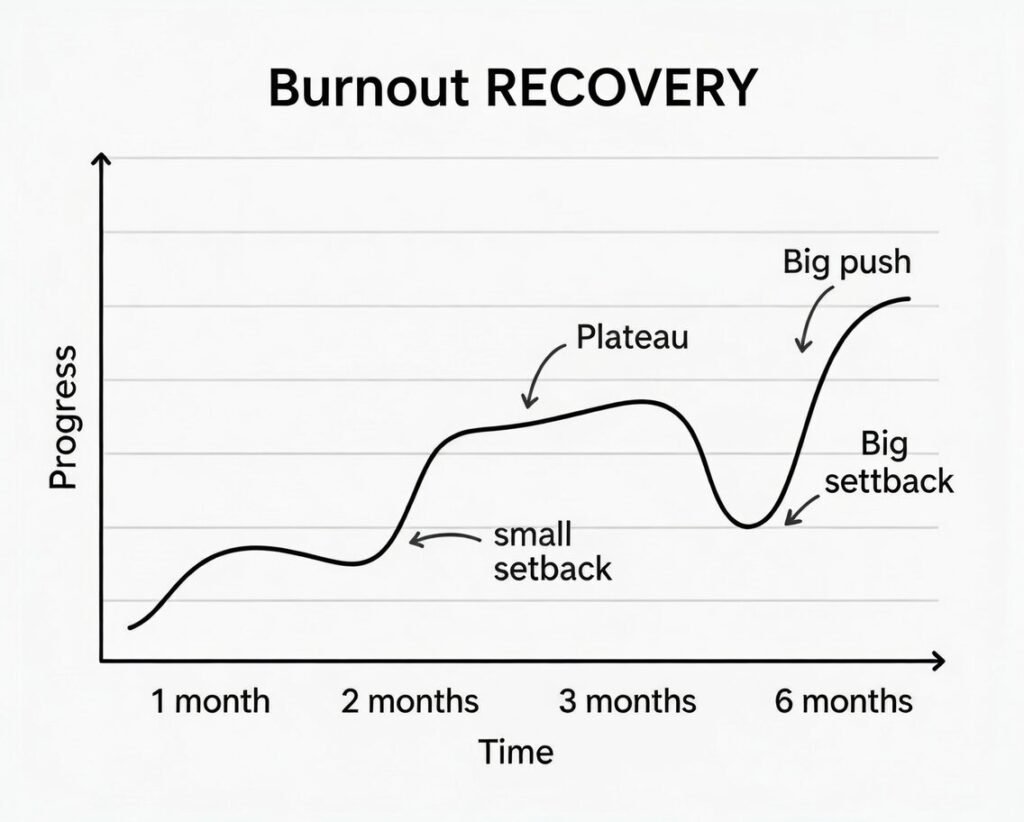
The plateaus aren’t failure. They’re consolidation.
Your nervous system is adjusting to the new baseline. Your brain is solidifying new patterns. Your body is integrating changes.
Plateaus where nothing seems to change for weeks? Those are necessary.
You Have Permission to Prioritize Recovery Over Everything Else
“But I have responsibilities.” “But my career.” “But what will people think?”
Your health is the foundation everything else sits on.
If the foundation crumbles, everything collapses.
Taking 6-12 months to properly recover > Rushing back, crashing again, and losing years to repeated burnout cycles.
You Have Permission to Believe It Will Actually Work
When you’re at week 6 and still feel terrible, it’s hard to believe recovery is happening.
But it is.
Your nervous system is recalibrating (you can’t feel it yet). Your cortisol regulation is improving (you can’t measure it). Your sleep architecture is repairing (you only notice the end result). Your brain structure is changing (invisibly, gradually).
Healing is happening at the biological level before you feel it psychologically.
Trust the process. Maintain the practices. Give it time.
You Have Permission to Not Be the Same Person You Were Before
“When will I get back to normal?”
Maybe never. Maybe that’s good.
The person you were before? That person burned out.
Recovery isn’t returning to who you were. It’s becoming someone sustainable.
- Different pace (slower, more sustainable)
- Different standards (good enough, not perfect)
- Different boundaries (firm, not negotiable)
- Different priorities (health, not just achievement)
- Different self-concept (whole person, not just worker)
This isn’t losing yourself. It’s finding a version that can actually last.
The Bottom Line
Burnout recovery takes months because:
- Biological systems need time – Nervous system, cortisol regulation, sleep architecture, cognitive function, emotional regulation all require weeks to months to repair
- Damage accumulated over time – You didn’t burn out in 2 weeks, you won’t recover in 2 weeks
- Multiple systems are affected – Not just “tiredness,” but physiological changes across multiple body systems
- Healing is gradual, not instant – Like a broken bone, the knitting happens invisibly before strength returns
Your realistic timeline:
- Early burnout: 6-12 weeks
- Moderate burnout: 3-6 months
- Severe burnout: 6-18 months
What affects your timeline:
- Severity (more damage = longer repair)
- Consistency (maintained practices = faster recovery)
- Environment (toxic workplace = extended timeline or impossible recovery)
What you need to do:
- Accept the timeline without shame
- Maintain recovery practices consistently
- Hold boundaries even when feel better
- Remove yourself from toxic environments
- Trust biological healing happening beneath the surface
- Give yourself the time this actually requires
The truth nobody wants to tell you:
This takes longer than you want.
The truth that actually helps:
Taking the time now means you won’t have to do this again in 6 months.
Sustainable recovery beats rushed relapse.
Your Next Step
Don’t waste time trying to speed up biology. Use the time wisely by doing what actually works.
Download: Burnout Recovery Starter Kit
Get the practical strategies for each stage:
- Crisis stabilization (stopping the bleeding)
- Foundation building (establishing routines)
- Identity rebuilding (becoming sustainable)
- Tracking progress (knowing it’s working)
Continue Reading:
- The 5 Stages of Burnout Recovery – Detailed breakdown of each recovery phase
- What Actually Works in Burnout Recovery – Evidence-based strategies and implementation
- Can You Recover While Still Working? – Assessment tool for your specific situation
- 13 Early Warning Signs of Burnout – Catch it earlier next time