

I was doing everything “right.”
Morning routine: optimized. Calendar: time-blocked. Goals: SMART and tracked in excel sheets. I had systems for my systems. I was productive as hell.
I was also:
- Exhausted by 2 PM every day
- Resentful of my own calendar
- Dreading Mondays by Saturday afternoon
- Achieving goals that felt hollow when I hit them
The worst part? I kept thinking the solution was to be more disciplined. More consistent. More optimized.
I was trying to be more efficient at the very things that were destroying me.
Then I tried something different. Instead of asking “How can I do more?” I asked: “What if I’m spending most of my energy on things that drain me?”
That question led to what I now call The Energy Audit. And it changed everything.
The Productivity Trap We Don’t Talk About
Here’s what nobody tells you about productivity culture:
It assumes all hours are equal.
Work 8 hours, get 8 hours of output. Exercise for 30 minutes, get 30 minutes of health benefits. Spend quality time with family, check the “relationships” box.
But anyone who’s ever been truly exhausted knows: Not all hours cost the same.
Some activities give you energy. They leave you feeling alive, engaged, restored. You could do them for hours and emerge more yourself than when you started.
Other activities drain you. They leave you depleted, resentful, fragmented. Even 30 minutes feels like running through mud.
Productivity culture tells us to optimize how we spend our time.
Energy thinking tells us to audit how we spend our life force.
There’s a massive difference.
The Optimization Obsession
We’ve been taught to ask:
- How can I get more done?
- What’s the most efficient use of my time?
- How do I eliminate wasted hours?
These aren’t bad questions. But they’re incomplete.
They assume the problem is efficiency when the real problem is often allocation.
It doesn’t matter how efficiently you do something that shouldn’t be in your life at all.
You can be incredibly productive at draining yourself dry.
I see this everywhere:
- The founder who’s “crushing it” while slowly dying inside
- The parent who’s “keeping it together” while running on fumes
- The professional who’s “moving up” while moving away from themselves
From the outside, it looks like success. From the inside, it feels like drowning in slow motion.
What Gets Measured (And What Doesn’t)
Our culture measures:
- Tasks completed ✓
- Goals achieved ✓
- Income generated ✓
- Promotions earned ✓
- Output produced ✓
What we don’t measure:
- How you feel at the end of the day
- Whether work energizes or depletes you
- If your relationships are sustaining or draining
- Whether your life is feeding your soul or consuming it
We optimize for metrics that look good in retrospect while ignoring the lived experience of actually being alive.
And then we wonder why we’re burned out despite “having it all together.”
The Energy Audit: A Different Framework
The Energy Audit is radically simple. It requires no app, no system, no optimization.
Just two lists and 20 minutes of brutal honesty.
The Two Lists
List 1: What Gives You Energy
Write down every activity, relationship, project, routine, or dynamic that consistently leaves you feeling:
- Alive and engaged (not just entertained)
- Restored or recharged (not just rested)
- Proud or fulfilled (not just accomplished)
- More like yourself (not performing)
These are your energy sources.
Important: Don’t filter based on productivity. Rest counts. Play counts. “Unproductive” things that make you feel alive count.
List 2: What Drains You
Write down every activity, relationship, project, routine, or dynamic that consistently leaves you feeling:
- Depleted or exhausted (beyond normal tiredness)
- Resentful or obligated (even if you “should” want to do it)
- Smaller or less yourself (like you’re shrinking)
- Scattered or fragmented (can’t think clearly after)
These are your energy drains.
Important: Be specific. “Work” is too vague. Which meetings? Which projects? Which parts of your role? Name the actual things.
My Lists (As Example)
Energy Sources:
- Writing in the morning before anyone else is awake
- Deep 1-on-1 conversations (not group socializing)
- Teaching or mentoring someone genuinely curious
- Hiking alone with a podcast…or an interesting audio book
- Working on creative projects with no deadline
- Laughing until I cry with my wife and son
- Reading philosophy before bed
- Solving complex problems in flow state
Energy Drains:
- Status update meetings that could be emails
- Small talk at networking events
- Managing someone else’s emotional reactions to my decisions
- Social media when I’m tired (endless scroll)
- Being “on” in group settings longer than 2 hours
- Context switching between unrelated tasks
- Explaining the same thing repeatedly
- Commitments I only keep out of guilt
The Shocking Revelation
Once you have your two lists, ask yourself:
What percentage of my time do I spend on sources vs. drains?
For most people, the answer is devastating:
- 20-30% on energy sources
- 70-80% on energy drains
No wonder you’re exhausted.
You’re not lazy. You’re not weak. You’re not failing at productivity.
You’re spending most of your life doing things that consume you faster than you can recover.
And then you’re trying to “optimize” your way out of the hole by being more disciplined at the very activities draining you.
It’s like bailing water while someone keeps drilling holes in your boat, and your solution is to bail faster.
The Side-by-Side Revelation
Look at your lists side by side. What patterns emerge?
For me, I noticed:
Energy sources all involved DEPTH:
- Deep conversations (not shallow networking)
- Deep work (not scattered multitasking)
- Deep rest (not distraction scrolling)
Energy drains all involved BREADTH:
- Spreading myself thin across obligations
- Surface-level interactions with too many people
- Switching contexts constantly
- Trying to be everything to everyone
The insight: I needed to design for depth, not breadth.
One strategic question changed everything: “How can I say no to more things so I can say yes more deeply to fewer things?”
The Three Types of Drains
Not all drains are equal. Understanding the difference is crucial.
Type 1: Necessary Drains (Worth It)
Some things drain you but are worth doing:
- Difficult conversations that move relationships forward
- Hard work on meaningful projects (effort ≠ drain)
- Taxes and admin (unavoidable adulting)
- Caring for people you love (even when exhausting)
These drains are investments. They cost energy but create something valuable.
The strategy: Accept them. Build in recovery time after. Don’t try to eliminate…manage.
Type 2: Optional Drains (Release These)
Some things drain you and serve no real purpose except obligation, guilt, or inertia:
- Social obligations you only attend out of guilt
- Committees you joined years ago and no longer care about
- “Networking” events that feel transactional
- Friendships that take more than they give
- Projects you’re only continuing because you started them
- News and social media consumption out of habit
These drains are choices. You’re allowed to stop.
The strategy: Systematically eliminate. Start with the easiest. Build momentum.
Permission statement: “I can honor what this once gave me while acknowledging it’s time to let it go.”
Type 3: Hidden Drains (You Didn’t Realize)
Some drains are invisible until you name them:
- Keeping a mental inventory of everyone else’s needs
- Moderating your personality to fit in
- Avoiding necessary conflict (the drain of carrying unspoken things)
- Unfinished projects creating background anxiety
- Physical environments that feel chaotic or sterile
- Relationships where you can’t be fully yourself
These drains are often cultural expectations internalized as personal responsibility.
Examples:
- Women often carry the “emotional labor” drain of managing everyone else’s feelings
- People-pleasers drain themselves trying to keep everyone happy
- Perfectionists drain themselves re-doing “good enough” work
The strategy: Name them. Question if they’re actually yours to carry. Create boundaries.
What to Do With Your Findings
Having the lists is powerful. But useless without action.
Here’s how to actually change things:
Step 1: Protect Your Energy Sources (Non-Negotiable)
Look at your energy sources. Pick 1-3 that are most important.
Ask:
- What would it look like to protect these fiercely?
- What boundaries would that require?
- What would I need to say no to?
Example from my life:
Writing in the morning is my #1 energy source. To protect it:
- No meetings before 11 AM (boundary)
- Phone stays in another room (removal of distraction)
- I don’t check email until after writing (sequence protection)
- I say no to breakfast meetings (hard boundary)
This felt selfish at first. Now I see it as self-preservation.
Your turn: Pick one energy source. What’s one boundary that would protect it?
Step 2: Eliminate Optional Drains (Start Small)
Look at your Type 2 drains (optional ones). Pick the easiest one to eliminate.
Not the biggest. Not the most impactful. The easiest.
Why? Because you need momentum. One small win creates energy for the next.
Examples of small eliminations:
- Unsubscribe from 10 email lists (5 minutes)
- Resign from one committee (one email)
- Stop attending one recurring meeting (one conversation)
- Delete one draining app from your phone (30 seconds)
- Say no to one social obligation this week (one text)
Each small elimination creates space.
Your turn: What’s one optional drain you could eliminate this week?
Step 3: Manage Necessary Drains (Strategic)
For Type 1 drains (necessary but draining), you can’t eliminate them. But you can manage them better.
Strategies:
Batching:
- Group similar draining tasks together
- Do them all in one contained time block
- Recover fully after
Time-boxing:
- Limit how long you’ll spend on draining but necessary tasks
- “I’ll spend 1 hour on admin, then stop”
Bookending:
- Put energizing activities before and after draining ones
- Recovery as scheduled, not afterthought
Delegation:
- Can someone else do this?
- Can you hire this out?
- Can you automate it?
Reframing:
- Sometimes the drain is our resistance, not the task
- “I get to handle my taxes” vs. “I have to handle my taxes”
Your turn: Pick one necessary drain. Which strategy would help you manage it better?
Step 4: The 80/20 Shift
Here’s the goal: Shift your energy allocation over the next 3-6 months.
Current state (most people):
- 20-30% energy sources
- 70-80% energy drains
Target state:
- 50-60% energy sources
- 40-50% energy drains (mostly necessary ones)
You won’t get there overnight. But you can move toward it systematically:
Month 1: Eliminate 2-3 optional drains. Protect 1 energy source. Month 2: Eliminate 2-3 more. Better manage 1 necessary drain. Month 3: Add back 1 energy source you’d abandoned.
Small shifts compound.
Making Real Changes: What Gets in the Way
You now know what drains you and what doesn’t. So why is it hard to change?
Obstacle 1: Guilt
“But I should want to do this.” “People are counting on me.” “I’ll disappoint them.”
Reality check: Your guilt is often about other people’s comfort, not actual harm.
Saying no to what drains you isn’t selfish. It’s honest.
Showing up resentful and depleted? That’s not serving anyone.
Obstacle 2: Identity
“I’ve always been the person who…” “I’m known for…” “It would be weird if I stopped…”
Reality check: You’re allowed to outgrow identities that no longer fit.
The person you’re becoming might need different things than the person you were.
Obstacle 3: Fear of Missing Out
“What if I need this connection later?” “What if this becomes important?” “Everyone else is doing it…”
Reality check: You’ll miss out on some things. That’s the point.
You can’t do everything. Choosing energy sources means saying no to some things.
Better question: What are you currently missing out on by being too drained to show up fully for what matters?
Obstacle 4: Not Knowing What You Want
“I know what drains me but I don’t know what gives me energy anymore.”
Reality check: That’s often because you’ve been drained for so long, you’ve forgotten.
Start by eliminating drains. Energy sources will become clearer when you have capacity to notice them.
Experiment: What did you love doing before you got “too busy”? Try it again.
This Is Ongoing Work, Not One-Time
The Energy Audit isn’t something you do once and never revisit.
Why? Because:
- Your life changes
- Your needs evolve
- What once energized you might stop
- New drains sneak in
I revisit my lists quarterly. Every 3 months:
- What’s currently giving me energy?
- What’s currently draining me?
- What needs to shift?
It takes 15 minutes and saves me from months of burnout.
Start Small, Start Now
You don’t need to overhaul your entire life this week.
Just do this:
Today: Make your two lists (20 minutes)
This week: Eliminate one optional drain
This month: Protect one energy source with a real boundary
This quarter: Shift your ratio by 10%
Small shifts compound. Trust the process.
What’s Next?
The Energy Audit is one piece of a larger year-end reflection framework I created.
Year’s End, New Beginning is a 50-page guided workbook that includes:
- The complete Energy Audit with follow-up exercises
- How to identify what’s draining you that you’re not even aware of
- Strategic planning based on energy, not just goals
- AI prompts to spot blind spots
- Quarterly check-ins to stay aligned
Get it here: Year End Reflection Guide
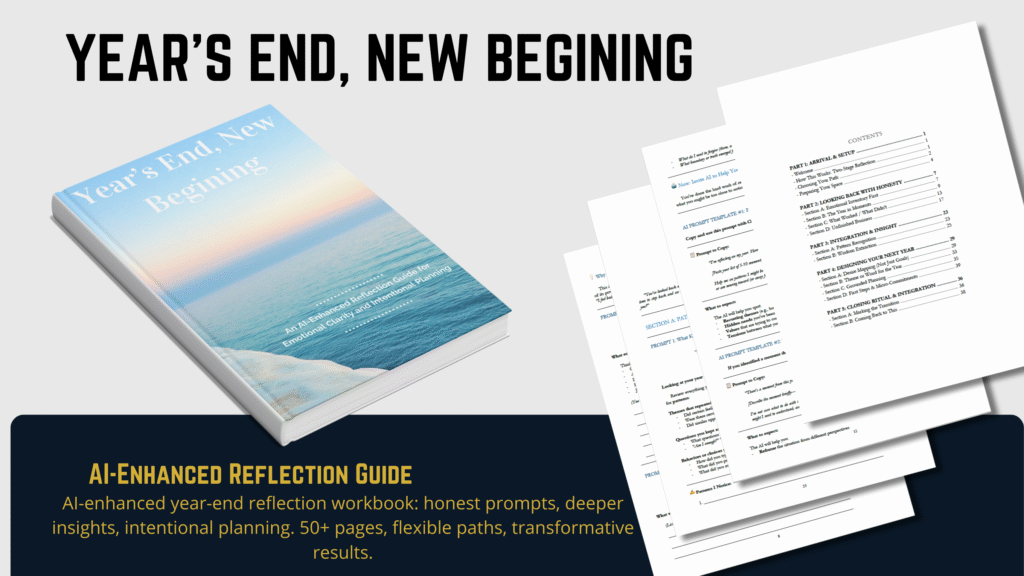
Or if you just want to start with the Energy Audit, that’s perfect. Do the two lists. See what you discover. Make one small change.
That alone is powerful.
Your Turn
I’m curious: What’s one thing that drains you that you could realistically eliminate this week?
Drop it in the comments. Sometimes just naming it publicly makes it easier to follow through.
Related Posts in This Series:
- Previous: Why Most Year-End Reflections Fail (And What to Do Instead)
- Coming next week: “How to Use AI as a Reflection Partner (Without Losing Your Humanity)”
- Week 4: “Closure Rituals: How to Actually Let Go of What’s Unfinished”
Leave a Reply