
Every December, I’d sit down with my journal, a cup of coffee, and a growing sense of dread.
Time for the year-end review.

I’d pull up my journal, excel templates, open my goal tracker, and start the familiar ritual: List accomplishments. Analyze gaps. Rate myself 1-10 in various life areas. Set ambitious goals for next year.
It looked productive. It felt thorough. And it left me feeling like I’d just had a performance review with the world’s harshest boss…myself!
Sound familiar?
Here’s what I’ve learned after years of this pattern: Most year-end reflections are not designed to help you understand your year. They’re designed to help you judge it.
And there’s a better way.
The Three Fatal Flaws of Traditional Year-End Reviews
Flaw #1: They Start With Judgment, Not Understanding
Open any year-end reflection template and you’ll see variations of:
- “What did you accomplish this year?”
- “Rate yourself 1-10 in: Career, Health, Relationships, Finance…”
- “Where did you fall short of your goals?”
Notice the pattern? These questions assume you should already know what success looks like and that you’re being measured against it.
But what if you had a year of surviving, not thriving? What if your goals changed halfway through because you changed? What if the most important thing that happened wasn’t on any achievement list?
Starting with judgment triggers our inner critic immediately. We scan our year looking for evidence of inadequacy. We compare ourselves to impossible standards, the highlight reels of others, the fantasy version of ourselves we imagined in January, the person we “should” have become.
This isn’t reflection. This is self-prosecution.
Real understanding requires we set down judgment long enough to simply see what was.
Flaw #2: They’re One-Size-Fits-All
Most year-end reflection tools treat every person, every year, every life circumstance as if they’re identical.
Did you:
- Have a baby?
- Lose a parent?
- Navigate a divorce?
- Survive a layoff?
- Battle chronic illness?
- Experience burnout?
- Have the best year of your life?
The template doesn’t care. Same questions. Same framework. Same expectation that you’ll produce insights as neatly as you’d fill out a form.
But humans aren’t forms. Lives aren’t templates.
A year of healing needs different questions than a year of building. A year of loss needs different reflection than a year of achievement. A year of transition needs space to acknowledge: “I don’t know what this was yet.”
Flaw #3: They Focus on Output, Not Identity
Traditional reflections ask: What did you DO?
Better reflections ask: Who are you BECOMING?
This might sound like semantic nitpicking, but it’s a fundamental shift in focus:
Output-focused questions:
- What did you accomplish?
- What goals did you hit?
- What can you show for this year?
Identity-focused questions:
- What did you learn about yourself?
- What patterns kept showing up?
- What’s trying to emerge in your life?
- What are you moving toward?
The first set measures you against external standards. The second helps you understand your internal landscape.
The first treats you like a productivity machine. The second treats you like a human being on a journey.
You’re not a project to be optimized. You’re a person trying to live intentionally.
What Science Tells Us About Effective Reflection
Before we dive into the framework, let’s look at what research actually says about reflection… because it turns out, the way most of us reflect might be doing more harm than good.
Not All Reflection Is Created Equal
A 2017 study published in Self and Identity found something fascinating: self-reflection only supports well-being when it cultivates insight rather than judgment.¹
The researchers distinguished between two types of reflection:
Type 1: Evaluative Reflection
- Focused on judging past actions
- “Did I do well enough?”
- “Where did I fail?”
- Linked to rumination and negative emotions
Type 2: Insight-Oriented Reflection
- Focused on understanding and growth
- “What did this teach me?”
- “Who am I becoming?”
- Linked to increased well-being and resilience
Traditional year-end reviews? Almost entirely Type 1.
The result: We think we’re being productive when we’re actually training ourselves to ruminate.
Reflection as Identity Work
Recent research is reframing what reflection is actually for.
A 2025 study in Studies in Continuing Education describes reflection not as evaluation of past performance, but as “identity work”: an ongoing practice of understanding who you are and who you’re becoming.²
This isn’t just semantic. The researchers found that when reflection is approached as identity formation rather than performance review, it leads to:
- More sustainable personal growth
- Greater resilience during challenges
- Clearer sense of purpose and direction
- Less self-criticism and rumination
In other words: Asking “Who am I becoming?” isn’t just a nicer question than “What did I accomplish?”. It’s a neurologically and psychologically more effective one.
Your Brain on Future-Focused Reflection
Here’s where it gets really interesting.
A 2018 neuroscience study used fMRI to observe brain activity during different types of reflection.³ When participants reflected on:
Past mistakes and failures:
- Activated networks associated with negative emotion
- Increased activity in regions linked to rumination
- Decreased activation in forward-thinking areas
Who they’re becoming and future aspirations:
- Activated medial prefrontal cortex (associated with positive self-concept)
- Engaged networks related to optimism and motivation
- Increased neural patterns linked to growth mindset
Translation: Your brain literally responds differently to “What did I do wrong?” vs. “Who am I becoming?”
The first triggers self-protection and rumination. The second activates possibility and growth.
The Decision-Making Advantage
A 2023 study in Thinking & Reasoning tested whether reflection actually leads to wiser choices.⁴
The finding: It depends on the type of reflection.
Constructive, future-oriented reflection:
- Improved decision-making quality
- Increased clarity about values and priorities
- Enhanced ability to learn from experience
Ruminative, judgment-focused reflection:
- Actually hindered decision-making
- Increased doubt and second-guessing
- Led to decision paralysis
So when you sit down to “reflect on your year,” the questions you ask literally determine whether you’ll make better decisions or just feel worse.
The Self-Compassion Factor
A 2023 review in Verywell Mind synthesized decades of research on self-reflection and mental health.⁵ The conclusion:
Self-reflection supports mental well-being when it:
- Focuses on growth and learning (not judgment)
- Cultivates self-compassion (not self-criticism)
- Looks toward future aspirations (not just past failures)
- Seeks understanding (not evaluation)
Self-reflection harms mental well-being when it:
- Centers on harsh self-evaluation
- Focuses primarily on failures and shortcomings
- Compares yourself to impossible standards
- Leads to rumination without insight
This explains why traditional year-end reviews often leave us feeling worse, not better. They’re structurally designed to trigger the exact type of reflection that research shows is harmful.
The Practical Implication
All of this research points to the same conclusion:
The framework matters more than the effort.
You can spend hours reflecting in ways that increase rumination, self-criticism, and decision paralysis. Or you can spend the same time reflecting in ways that cultivate insight, growth, and clarity.
The difference isn’t how long you reflect or how thorough you are.
It’s the questions you ask.
Which brings us to…
A Better Framework: Five Core Questions
After years of failed reflections and deep dives into research on what actually works, I built a different approach. One that aligns with how our brains actually process reflection, starting with understanding and identity, not judgment and evaluation.
The research is clear: reflection that focuses on who you’re becoming, what you’re learning, and how you want to grow leads to better psychological outcomes than reflection that judges what you did or didn’t accomplish.⁶
This framework embodies that principle in five core questions.
Question 1: How Do I Feel About This Year?
Before you analyze anything, before you list a single accomplishment or failure, start here:
In one word, how do you feel about this past year?
Don’t overthink it. Write the first word that comes.
Tired? Proud? Disappointed? Grateful? Confused? Relieved?
Got your word? Good. Now expand:
What’s underneath that word?
If you said “tired” what KIND of tired? Physical exhaustion from new parent sleep deprivation? Emotional exhaustion from navigating a toxic workplace? Creative exhaustion from pouring yourself into a project?
If you said “grateful” grateful for what, specifically? For getting through something hard? For unexpected joy? For relationships that showed up?
If you said “disappointed” disappointed in yourself? In others? In how something turned out? In expectations that didn’t match reality?
Why start here?
Because emotions are data. They tell us what mattered, what hurt, what needs attention. And they ground the entire reflection in truth instead of performance.
This is an ancient practice, actually. Stoic philosophers like Marcus Aurelius believed that naming an emotion precisely strips it of its power to overwhelm you. When you can say, “I feel disappointed in how I handled boundaries at work,” instead of just “I feel bad,” you move from fog to clarity.
Your turn: Set a timer for 5 minutes. Write your one-word feeling, then explore what’s underneath it. Don’t edit. Just write.
Question 2: What Moments Defined My Year?
Now that you’ve named how you feel, let’s map the terrain of your year.
List 5-10 moments that shaped your year.
Not achievements. Not milestones. Moments.
These can be:
Big moments:
- Job changes, moves, births, deaths
- Major decisions or turning points
- Beginnings or endings
Hard moments:
- Conflicts, failures, disappointments
- Health scares or losses
- Times you felt lost or afraid
Surprising moments:
- Unexpected joys or plot twists
- Chance encounters that mattered
- Times things didn’t go as planned (in a good way)
Ordinary moments:
- A conversation that shifted something
- A quiet evening that felt significant
- A realization while doing dishes
- A walk that changed your perspective
Don’t filter. Don’t judge. Just list what comes to mind.
Why this matters:
Your year wasn’t one long narrative. It was made of moments. Some were turning points. Some were quiet but profound. Some you wish you could redo. Some you’ll carry forever.
By listing them without judgment, you’re creating a map of what actually mattered to you, not what “should have” mattered, but what your memory held onto.
Example from my year:
- The morning I decided to quit my job (terrifying, liberating)
- My dad’s health scare in March (reminder of what’s actually important)
- The night I finished the first draft of my workbook (pride, relief)
- Conversation with a friend who called out a pattern I was blind to (uncomfortable, necessary)
- Ordinary Tuesday in July when I felt genuinely happy for no reason (noteworthy because rare)
Notice: These aren’t accomplishments. They’re moments that shaped me.
Your turn: List your 5-10 moments. Set a timer for 10 minutes. Trust your memory.
Question 3: What Gave Me Energy vs. Drained Me?
This is the question that changed everything for me.
For years, I focused on being more productive, more disciplined, more optimized. I added morning routines, time-blocking systems, focus techniques.
And I kept burning out.
Then I realized: I was spending most of my energy trying to be more efficient at things that were draining me.
So I tried a different approach: The Energy Audit.
Make two lists:
List 1: What gave you energy this year?
Think about activities, relationships, projects, or routines that left you feeling:
- Alive and engaged
- Restored or recharged
- Proud or fulfilled
- More like yourself
These are your energy sources. They don’t have to be “productive.” Rest counts. Play counts. Connection counts.
Examples:
- Deep conversations with close friends
- Writing in the morning before anyone else is awake
- Hiking on weekends
- Teaching or mentoring
- Creative projects with no deadline
- Laughing until I cried with my partner
List 2: What drained you?
What consistently left you feeling:
- Depleted or exhausted (beyond normal tiredness)
- Resentful or obligated
- Smaller or less yourself
- Scattered or fragmented
Be specific. “Work” is too broad. What ABOUT work? Which meetings? Which projects? Which dynamics?
Examples:
- Status update meetings that could have been emails
- Managing someone else’s emotional reactions
- Social obligations I said yes to out of guilt
- Scrolling social media late at night
- Avoiding a difficult conversation
- Trying to force a creative project that wasn’t working
Now, the crucial part:
Look at your two lists side by side and ask:
- Am I spending most of my time on sources or drains?
Most people discover they’re spending 60-80% of their time on things that drain them.
- Which drains are necessary vs. optional?
Some drains are necessary: Taxes are draining but required. Difficult but important conversations. Hard work on meaningful projects.
Some drains are optional: Commitments you only keep out of guilt. Relationships that take more than they give. Habits you maintain on autopilot.
- What deserves more protection next year?
Of your energy sources, which ones:
- Deserve more time and attention?
- Feel fragile and need protection?
- Could become even more central to your life?
Why this matters:
You can’t pour from an empty cup. But most of us are trying to do exactly that. Optimizing our productivity while ignoring what actually gives us energy to begin with.
Your turn: Spend 15-20 minutes on this. Create your two lists. Be brutally honest. No one else will see this.
Question 4: What Patterns Kept Showing Up?
You’ve now:
- Named how you feel
- Mapped your key moments
- Identified energy sources and drains
Now step back and look at the whole landscape:
What patterns do you notice?
Patterns might be:
Recurring themes:
- Did certain feelings, situations, or dynamics keep appearing?
- Did you face the same kind of challenge in different areas?
- Did similar opportunities keep presenting themselves?
Questions you kept wrestling with:
- “Am I enough?”
- “What do I actually want?”
- “Why does this keep happening?”
- “How do I set better boundaries?”
Behaviors or choices you made consistently:
- How did you typically respond to stress?
- What did you prioritize (consciously or unconsciously)?
- What did you avoid?
- Where did you show up vs. withdraw?
Example patterns from my year:
- I kept saying yes to things I didn’t want to do, then resenting them
- Every time I felt stressed, I worked MORE instead of stepping back
- I avoided difficult conversations until they became crises
- My best creative work happened when I protected morning time
Why this matters:
Patterns aren’t “good” or “bad”, they’re information. They show you:
- What you’re working on (even if unconsciously)
- What needs attention or healing
- What’s trying to emerge in your life
- Where you’re stuck or where you’re growing
But we’re often too close to our own lives to see our patterns clearly. That’s why the next step is crucial…
Optional: Use AI to spot what you can’t see
After you’ve done your reflection, try this experiment:
Open Claude or ChatGPT and paste a summary of your reflections. Then ask:
“Based on this, what patterns am I not seeing? What might I be avoiding or overlooking?”
I was skeptical the first time I tried this. But it pointed out connections I’d completely missed, things that were obvious once named but invisible to me while I was in it.
Example: I’d listed three separate “stressful situations” that seemed unrelated. The AI response: “These all involve situations where boundaries weren’t clear. You thrive when expectations are explicit and struggle when they’re ambiguous.”
Mind. Blown.
Your turn: Review everything you’ve written. What patterns emerge? Spend 10 minutes freewriting about what you notice.
Question 5: Who Am I Becoming?
This is the question that transforms everything.
Not “What did I accomplish?” Not “Where did I fall short?” But:
Who am I becoming through all of this?
This question shifts focus from:
- Output → Identity
- Achievement → Direction
- Performance → Evolution
- Judgment → Curiosity
To explore this, ask:
What am I moving TOWARD?
- Values, experiences, ways of being
- Example: “Toward authenticity,” “Toward deep work,” “Toward courage”
What am I moving AWAY FROM?
- Patterns, behaviors, dynamics that no longer serve you
- Example: “Away from people-pleasing,” “Away from burnout,” “Away from perfectionism”
What’s trying to emerge?
- New version of yourself
- Shift in priorities
- Change in what matters
What does future-me need from current-me?
- Healing before hustling?
- Boundaries before bigger goals?
- Rest before reset?
- Closure before opening new chapters?
Why This Question Works (According to Science)
Remember that neuroscience study I mentioned? This is the question that activates the “growth” networks in your brain rather than the “rumination” networks.³
When you ask “Who am I becoming?” you’re engaging in what researchers call “identity-based reflection”, the type that research shows leads to sustainable personal growth and resilience.²
You’re not evaluating yourself against external standards. You’re understanding your internal trajectory.
This isn’t just feel-good psychology. A 2025 study found that reflection supporting personal and identity development produces measurably better outcomes than evaluative reflection: greater clarity, more resilience during setbacks, and stronger commitment to meaningful change.⁶
Translation: This question isn’t just kinder. It’s more effective at actually helping you grow.
Example from my own reflection:
“I’m becoming someone who trusts that depth matters more than speed. Someone who chooses meaningful work over impressive work. Someone who’s learning to rest without guilt. Someone who says no more easily and yes more intentionally.”
That’s not a achievement list. It’s not a goal. It’s a direction.
And direction is more important than destination.
Your turn: Finish this sentence in as many ways feel true:
“I’m becoming someone who…”
Write for 10 minutes. Don’t edit. Let it flow.
Putting It Into Practice
“This sounds great, but when do I actually DO this?”
Fair question. Here’s how to make it happen:
Time Needed
Quick version (1 hour):
- Question 1: Emotional check-in (10 min)
- Question 2: Key moments (15 min)
- Question 3: Energy audit (20 min)
- Question 5: Who am I becoming (15 min)
Deep version (3-4 hours):
- All five questions thoroughly
- AI-assisted pattern recognition
- Additional processing time
Modular approach (8 sessions x 20-30 min):
- Break it into smaller chunks
- One question per session
- Perfect for busy people, parents, anyone without big time blocks
What You’ll Need
Practically:
- Quiet space (even 30 minutes of uninterrupted time)
- Something to write with (journal, doc, notes app)
- Optional: AI tool for pattern recognition (Claude, ChatGPT)
Emotionally:
- Willingness to be honest
- Self-compassion (this isn’t about judgment)
- Permission to feel whatever comes up
- Understanding that insight > completion
Common Obstacles (And Solutions)
“I don’t have time” → Start with the 1-hour quick version → Or break it into 20-minute sessions → Quality > quantity
“Big emotions come up and I get stuck” → That’s information, not failure → Take breaks when you need them → This isn’t a race → Consider talking to a therapist or trusted friend
“I don’t know what I want” → Start with what you DON’T want → Start with how you want to FEEL → That’s enough to begin
“I feel like I’m just complaining” → Honest assessment ≠ complaining → You can’t change what you won’t acknowledge → Clarity requires truth first
The AI Enhancement (Optional But Powerful)
One of the most surprising discoveries in my reflection journey: AI can help you see blind spots you’re too close to notice.
Here’s how I use it:
Step 1: Do Your Reflection First
This is crucial. AI doesn’t replace your emotional work…it augments it.
Spend time with the five core questions. Write out your thoughts. Do the hard work of remembering, feeling, and naming.
Step 2: Use AI for Outside Perspective
Once you’ve reflected, you can use AI as a thought partner. Some prompts I’ve found useful:
For Pattern Recognition:
"I'm reflecting on my year. Here are the key moments that defined it: [paste your list]. What patterns or themes do you notice that I might be missing?"For Energy Audit Strategy:
"Here's what gave me energy vs. drained me this year: [paste lists]. Which drains could I realistically reduce or eliminate? What boundaries would support this?"For Unresolved Situations:
"This situation from my year still bothers me: [describe]. I'm feeling [emotion]. What type of closure might I need external action or internal acceptance?"For Future Planning:
"Based on my reflections [summarize], what kind of year ahead would honor both my need for healing and my desire for growth?"Why This Works
AI is surprisingly good at:
- Spotting connections across complex qualitative data
- Seeing contradictions in our thinking
- Offering perspectives we hadn’t considered
- Reality-checking plans against stated values
Example from my experience:
I pasted my energy audit and asked for analysis. The response pointed out something I’d completely missed: “Your energy sources all involve depth (deep conversations, focused creative work, meaningful teaching). Your energy drains all involve breadth (scattered meetings, surface-level networking, multitasking). Consider: How can you design for depth?”
That one insight shaped my entire year.
Important Caveats
- AI isn’t a therapist or coach (get real humans for that)
- It works best after you’ve done your own thinking
- Treat it as one perspective, not gospel truth
- Your intuition trumps AI suggestions always
What to Do With Your Insights
You’ve now:
- Named how you feel about your year
- Mapped key moments
- Identified energy sources and drains
- Spotted patterns
- Explored who you’re becoming
Don’t let this just sit in your journal.
Here’s what to do next:
1. Distill Into Core Truths
From all your reflection, extract 2-3 core truths you want to carry forward. Things like:
- “I can’t pour from an empty cup, rest isn’t optional”
- “Avoiding hard conversations makes them harder”
- “I’m allowed to change my mind about what I want”
These become your anchors for the year ahead.
2. Identify What Needs Closure
From your patterns and unfinished business, what needs attention before you move forward?
- A conversation you’ve been avoiding?
- Grief you need to process?
- Forgiveness (of yourself or others)?
- A project to complete or officially abandon?
3. Design What’s Next (Not Just Goals)
Instead of jumping straight to goals, start with:
What do I want to FEEL more of next year?
- Peace, aliveness, connection, confidence, clarity, joy?
Then work backward:
- What would create more of those feelings?
- What would I need to protect, prioritize, or pursue?
This ensures your plans are aligned with what you actually want, not just what sounds impressive.
Final Thoughts: The Science of Self-Compassion
If you take one thing from this post, both from my experience and from the research, let it be this:
The goal of year-end reflection isn’t to produce a perfect analysis or judge your performance. It’s to understand yourself better so you can live more intentionally.
The science backs this up. Study after study shows that insight-oriented, growth-focused, self-compassionate reflection leads to better outcomes than evaluative, judgment-based reflection.¹²⁴⁵⁶
That means:
- It’s not just okay if emotions come up, it’s information
- It’s not a failure if you don’t have all the answers, it’s honesty
- It’s not weak to be kind to yourself, it’s neurologically smart
- It’s not indulgent to ask “Who am I becoming?” it’s evidence-based
You’re not broken if this brings up grief, regret, or confusion. You’re human. And you’re engaging in the exact type of reflection that research shows supports mental well-being and personal growth.
The practice of looking honestly at your life, without judgment, with compassion, with curiosity, isn’t just philosophical. It’s backed by neuroscience, psychology, and decades of research on what actually helps people grow.
Start with even just one question. See what it reveals. Be kind to yourself in the process.
Your brain will thank you. The research guarantees it.
What’s Next?
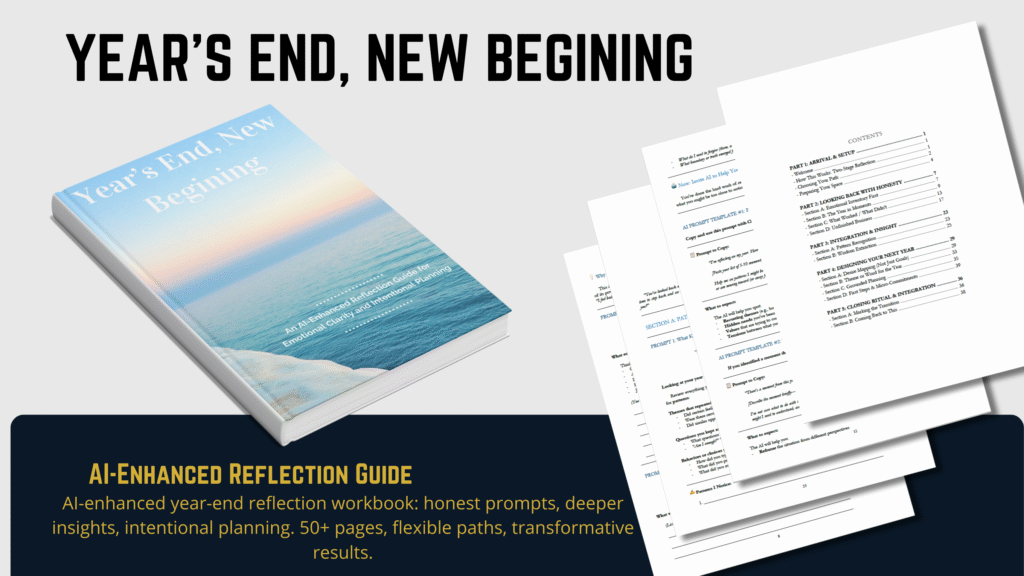
I created Year’s End, New Beginning, a 50-page guided workbook that walks you through this entire framework, plus:
- 18 AI prompt templates (tested and refined)
- Writing space for each question
- Emotional guidance for when big feelings arise
- Rituals for closure
- Grounded planning exercises
- Quarterly check-ins for the year ahead
It’s designed for real humans with messy lives who want clarity, not productivity theater.
Get it here: Year End Reflection Guide
Or if you’re not ready for that, no worries. Just try the five questions in this post. That alone is powerful.
What question resonates most with you? Drop a comment below. I’d love to know what your reflection process looks like.
Related Posts in This Series:
- Coming next week: “The Energy Audit: Why What Drains You Matters More Than What You Accomplish“
- Week 3: “How to Use AI as a Reflection Partner (Without Losing Your Humanity)”
- Week 4: “Closure Rituals: How to Actually Let Go of What’s Unfinished”
References & Further Reading
¹ Harrington, R., & Loffredo, D. A. (2017). “The Effect of Trait Self-Awareness, Self-Reflection, and Insight on Well-Being: A Mediational Analysis.” Self and Identity, 16(4), 440-459.
² Hibbert, P., et al. (2025). “Reassessing reflection: theorising reflection as identity work.” Studies in Continuing Education.
³ D’Argembeau, A., et al. (2018). “Neural Correlates of Reflection on Present and Past Selves in Medial Prefrontal Cortex.” Social Cognitive and Affective Neuroscience, 13(1), 1-10.
⁴ Scherer, A. M., et al. (2023). “Does reflection lead to wise choices?” Thinking & Reasoning, 29(3), 527-552.
⁵ Goldman, R. (2023). “How Self-Reflection Benefits Your Mental Health.” Verywell Mind. Retrieved from https://www.verywellmind.com
⁶ Hampton, J. (2025). “The Role of Self-Reflection in Personal Growth.” Journal of Personal Development Studies.
Want to dive deeper? These studies are available through academic databases or by searching the titles online. Most have accessible summaries or abstracts if you don’t have journal access.
Leave a Reply